The truth about SRCSD Teacher pay
Since Carol was elected to the School Board in 2014, Santa Rosa County teachers have received consistent, compounding raises every year. The data below is proof of her resolve to deliver the best possible pay for the educators who serve our students.
Key Facts
12 years on the School Board
Supported increasing teacher compensation throughout her service
Average teacher salary ranking improved from ~38th to 14th in Florida
47%+ cumulative teacher salary growth (2014–2026)
Teacher pay growth exceeded inflation
Teacher pay growth exceeded federal civilian GS base pay and military basic pay
Two impasse votes explained below
Teachers deserve competitive pay. They also deserve the confidence that the commitments we make today can still be honored years from now.
For twelve years I have approached every salary vote with two responsibilities in mind: providing competitive compensation for the dedicated employees of Santa Rosa County Schools, and protecting the long-term financial health of our district. Those responsibilities are not in conflict — they depend on one another.
My Record
During my twelve years on the Santa Rosa County School Board, I have consistently supported teacher salary increases. My voting record is public, consistent, and available for anyone to review.
Setting the Record Straight
During my twelve years on the School Board, I have supported increasing teacher compensation every year.
Questions have been raised about two impasse votes. Those votes did not determine whether teachers would receive raises. They concerned whether the district should approve additional recurring salary commitments beyond the compensation package already under consideration during collective bargaining.
The following explains why I believed supporting competitive teacher pay and maintaining a financially sound district were both essential responsibilities of a School Board member.
Results During My Service
Santa Rosa County's average teacher salary ranking improved from approximately 38th to 14th statewide.
Both average teacher pay and beginning teacher pay now exceed neighboring Escambia and Okaloosa Counties.
From the 2014-15 school year through the 2025-26 school year, cumulative teacher salary growth exceeded 47 percent.
Teacher pay increases outpaced inflation over the same period.
Teacher pay increases outpaced federal civilian General Schedule (GS) base pay.
Teacher pay increases outpaced military basic pay.
These results reflect deliberate budgeting, careful financial planning, and a consistent commitment to employee compensation.
Why Fiscal Responsibility Matters
Florida school districts operate under the Florida Education Finance Program (FEFP), which determines the funding available each year. School boards cannot simply vote to spend money that does not exist.
A recurring raise becomes part of every future budget. If recurring revenue does not increase at the same pace, the district eventually must reduce staff, eliminate programs, or draw down reserves that were built to protect students during emergencies or economic downturns. Responsible budgeting protects both employees and students from those outcomes.
The Board has long maintained a policy goal of preserving at least a 5% Financial Condition Ratio (FCR) to protect the district during economic downturns or unexpected emergencies. That standard guides my approach to every major compensation decision.
Taxpayers expect their elected school board members to balance today's needs with tomorrow's obligations. That is the standard I have followed for twelve years.
Understanding the Impasse Votes
The only two times I did not support the final salary package occurred after the collective bargaining process reached impasse. In both cases, I supported teacher salary increases during the bargaining process. The disagreement involved additional increases proposed after impasse that exceeded the recurring revenues available to sustain those commitments.
In both years, I supported salary increases. The disagreement was over how much could responsibly be committed on a recurring basis.
Supporting employees also means ensuring the district remains financially strong enough to honor those commitments year after year.
Results Matter
Public service should be measured by outcomes.
Teacher compensation steadily increased.
Teacher salaries became more competitive statewide.
Santa Rosa County maintained its tradition of strong academic performance.
The district continued investing in school safety, career education, and classroom opportunities.
Financial stability remained a guiding principle in Board decisions.
Competitive pay and fiscal responsibility are not competing priorities — they depend on one another. Lasting salary increases require lasting financial stability.
"Teachers deserve competitive pay. They also deserve a district that can keep the promises it makes. My record reflects both."
— Carol Boston, Santa Rosa County School Board · District 3
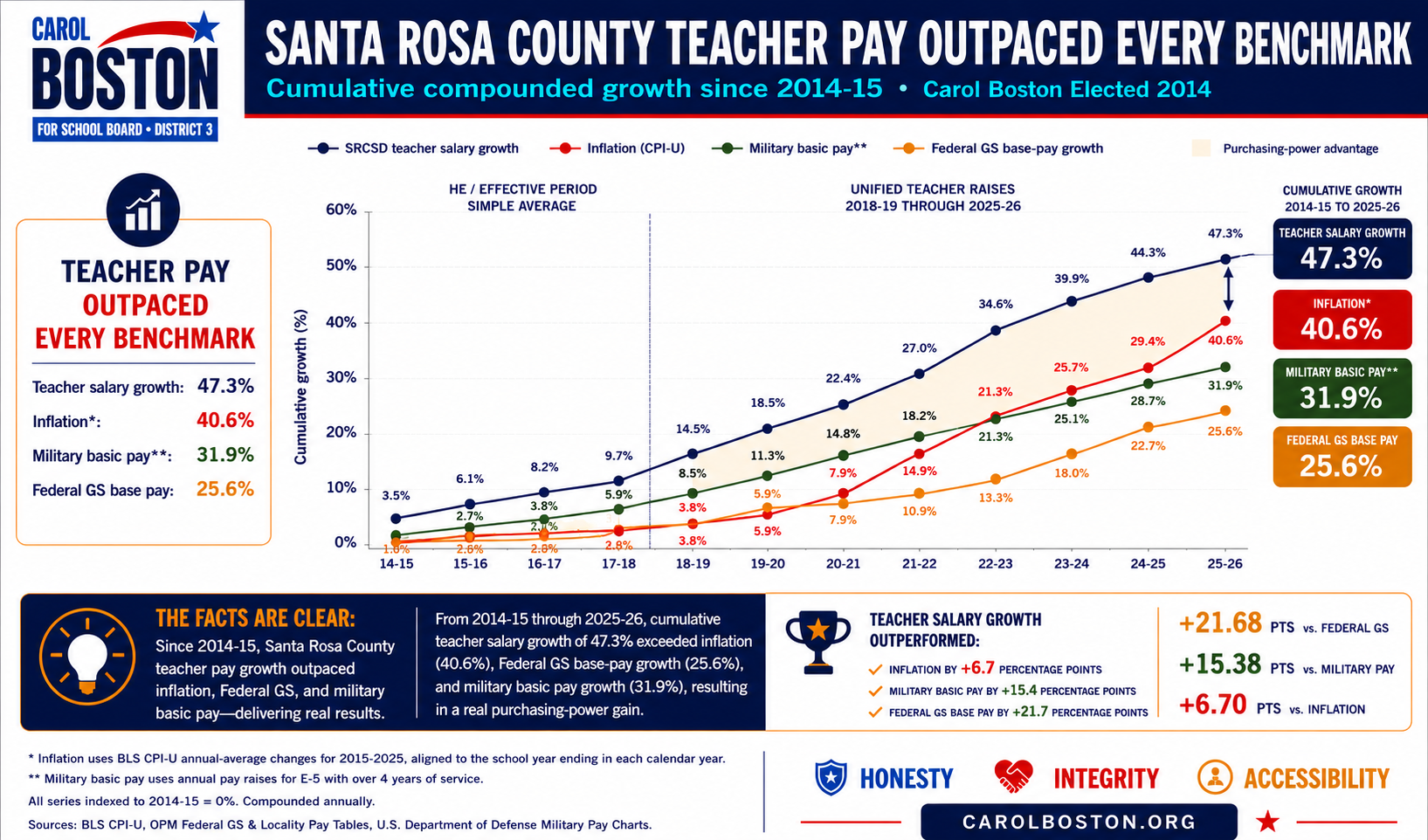
All series indexed to 2014-15 = 0% and compounded annually. Teacher and federal figures reflect recurring raises only; one-time bonuses and federal locality pay are excluded. * Inflation uses BLS CPI-U annual-average changes for 2015–2025, aligned to the school year ending in each calendar year. ** Military basic pay uses annual raises for E-5 with over 4 years of service. Sources: BLS CPI-U, OPM Federal GS & Locality Pay Tables, U.S. Department of Defense Military Pay Charts.
Why compounding matters
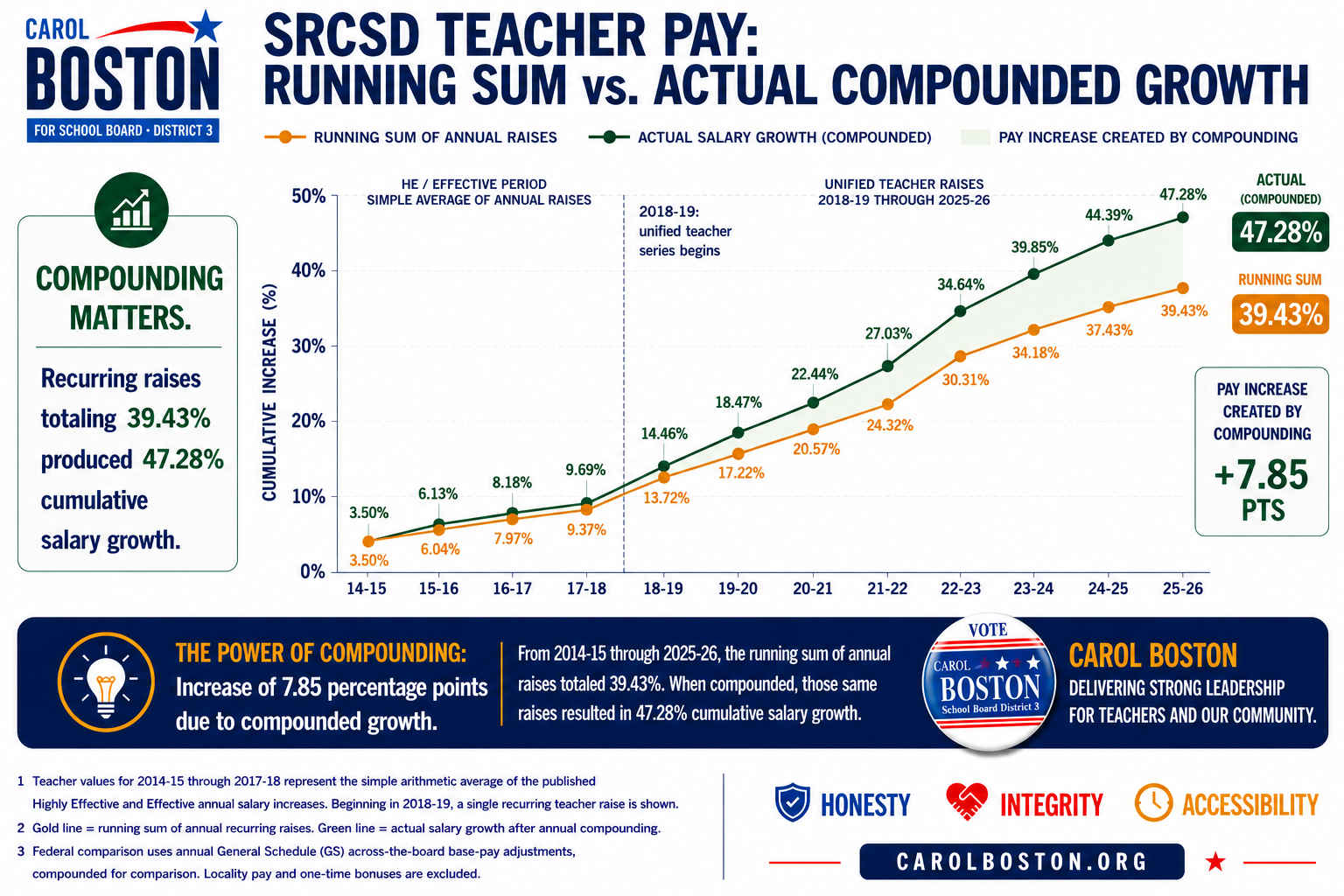
Locality pay and one-time bonuses are excluded.
Year-by-year raise history
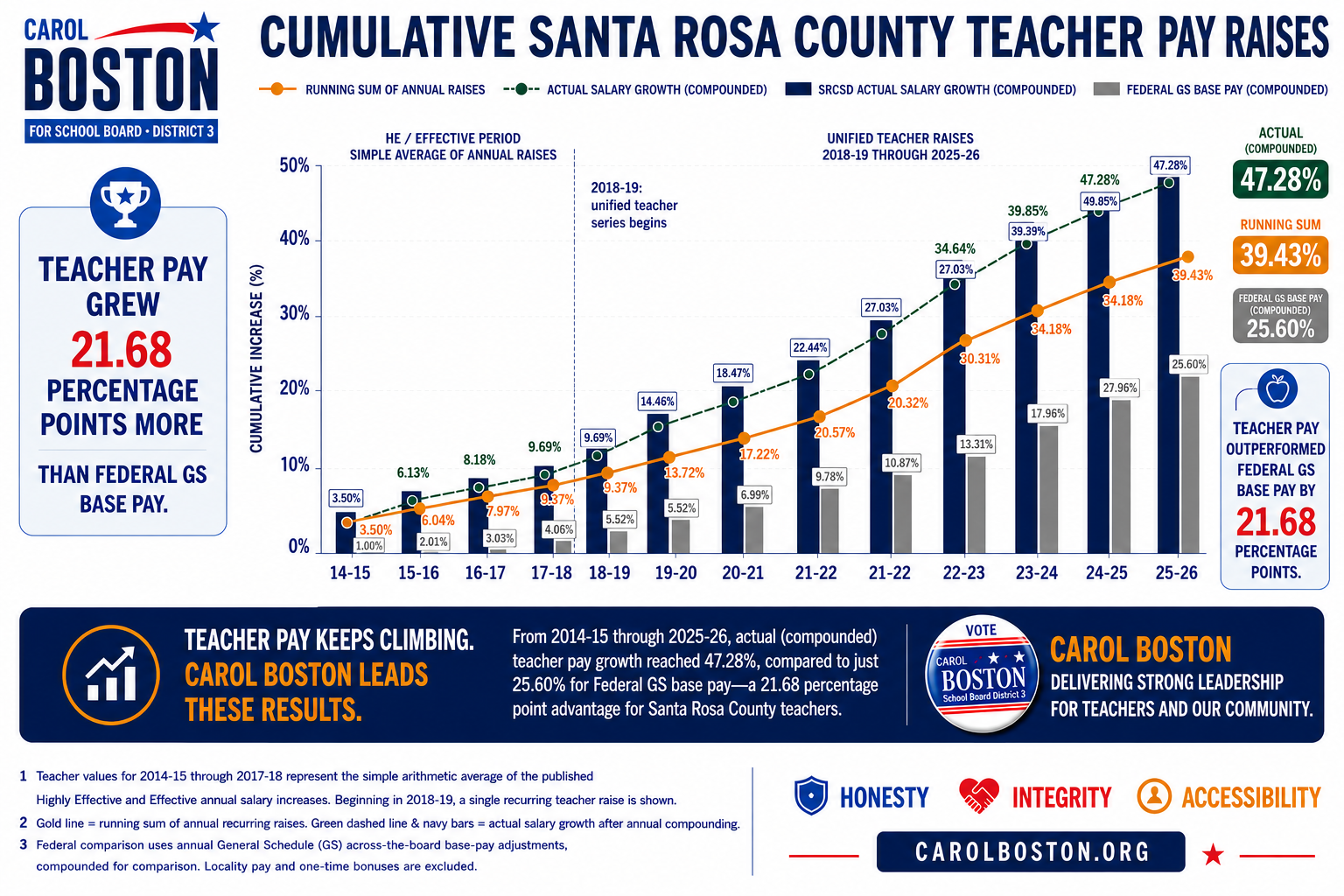
Gold line represents the running sum of annual recurring raises. Green line represents actual salary growth after compounding. Locality pay and one-time bonuses are excluded.
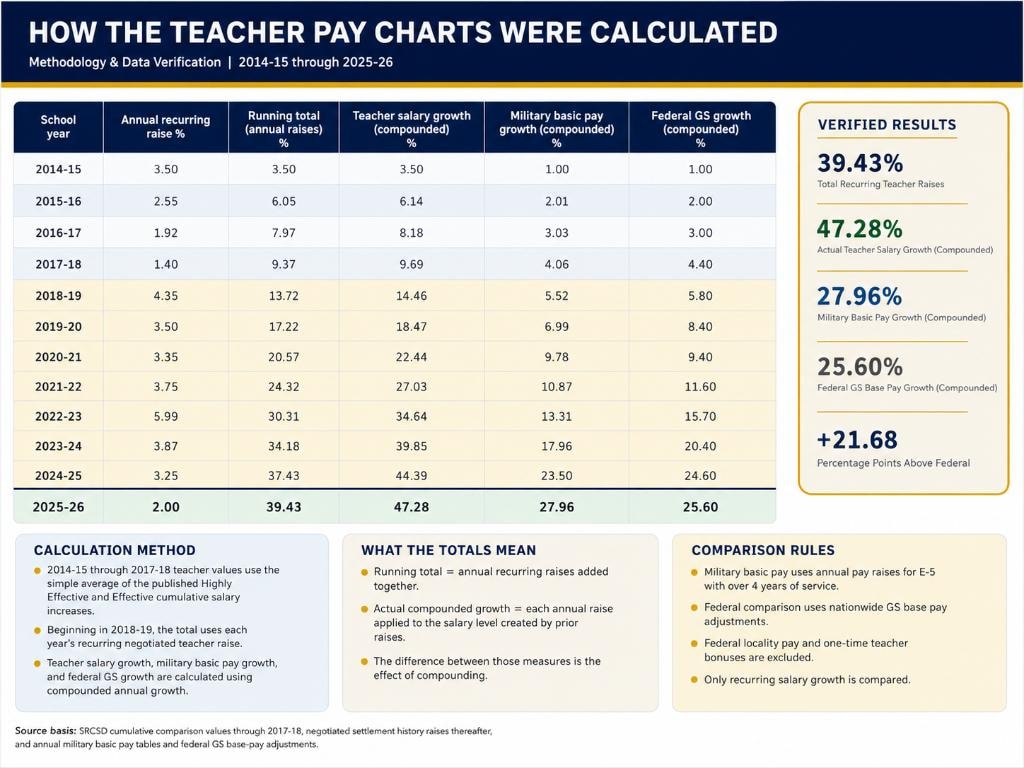
How the charts were calculated
Read Carol’s Op-Ed on teacher pay
Carol breaks down the numbers in her own words — what the data means for teachers, families, and the future of Santa Rosa County schools.
Read the Op-Ed →